Why Muslim Men Do Not Seek Therapy (And Why That Needs to Change)
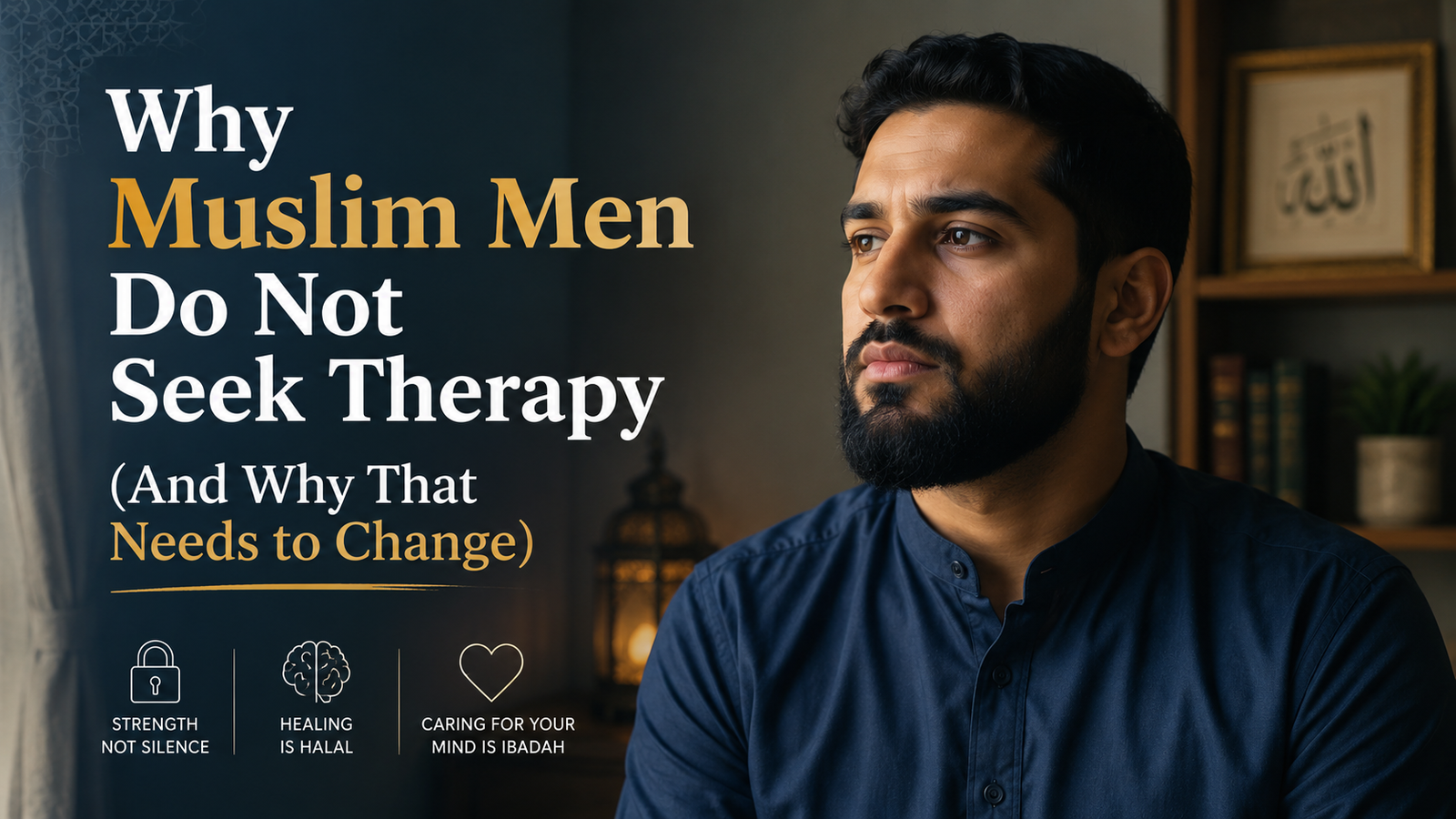
Men die from suicide at three to four times the rate of women. Muslim men are not exempt from this statistic. They are, in many communities, made more vulnerable by a specific combination of cultural expectation, religious misinterpretation, and the particular shame that attaches to a man who admits he is not coping. This article is for the men who are not coping, and for the people who love them.
The barriers are real, and they are layered
When Muslim men do not seek help, it is rarely because they are unaware that help exists. It is because the barriers to seeking it are genuinely significant, multiple, and often invisible to the people around them.
The provider identity. Many Muslim men carry a deeply internalised sense that their worth is tied to their ability to provide, protect, and remain strong. This is partly cultural, partly religious in its interpretation, and partly simply what they absorbed from watching the men around them. Admitting psychological struggle feels like admitting failure at the most fundamental level of what they understand themselves to be.
The fear of burdening others. Muslim men often describe not wanting to worry their wives, their mothers, their families. There is a specific kind of self-erasure in this: the man who is suffering silently because he does not want to be a burden to the people he is supposed to be protecting. This is experienced as love. It is also a form of isolation that kills people.
The cultural equation of silence with strength. In many cultures of origin represented in Western Muslim communities, emotional expressiveness in men is associated with weakness. Men were supposed to absorb difficulty without complaint. “Real men do not cry” is not unique to any one culture, but it takes on a particular weight when it is reinforced by community, family, and a misunderstanding of what Islamic masculinity actually teaches.
The religious framework misapplied. Concepts like sabr (patience) and tawakkul (trust in Allah) are genuinely powerful. They are also sometimes misapplied as reasons not to seek help. A man who is told that his depression is a test he should simply endure with patience has been given theology as a reason to suffer rather than as a companion through the process of seeking help and healing.
The specific shame of mental illness in men. Women’s emotional struggles, while still stigmatised, are at least more socially acknowledged. A woman who cries is seen as emotional. A man who cries is seen as broken. This asymmetry means that men with mental illness often do not recognise their own symptoms as such, because the internal narrative is not “I am sad and struggling” but “I am angry, I am failing, I am weak.”
How depression actually presents in men
One reason Muslim men so often do not recognise their own depression is that male depression frequently does not look like the commonly described picture of sadness and low mood. Male depression more often presents as:
Many men with these symptoms would never describe themselves as depressed. They would say they are stressed, burned out, tired, or just “not themselves.” The gap between the experience and the label is one of the reasons men delay seeking help until they are in crisis.
What Islam actually says about masculine vulnerability
The Prophetic model of masculinity includes vulnerability in ways that are almost never discussed in Muslim communities. The Prophet Muhammad (peace be upon him) wept. He wept at the death of his son Ibrahim. He wept at the death of companions. He said: “The eyes shed tears and the heart feels grief, but we do not say anything except that which pleases our Lord.” He named his grief. He did not hide it.
The Prophet sought counsel. He consulted Khadijah when he was frightened and overwhelmed by the first revelation. He discussed his inner states with those close to him. He did not manage his psychological life in isolated silence.
The Islamic ideal of strength is explicitly not the suppression of emotion. The Prophet defined the strong man as the one who controls himself in anger, not the one who feels nothing. Self-mastery is not the same as emotional numbness. One is a virtue. The other is a symptom.

What therapy looks like for men who have never tried it
Many Muslim men imagine therapy as lying on a couch and weeping about their childhood while a stranger takes notes. That picture bears almost no relationship to what good therapy actually involves.
Therapy is a structured, purposeful process. Many modalities used with men are highly practical and solutions-focused. CBT works on specific thought patterns and behaviours. Problem-solving therapy focuses on practical strategies. Trauma-focused work addresses specific roots of current difficulties. You do not spend sessions talking in circles. You work toward specific outcomes.
A good therapist meets you where you are. If you are not comfortable with emotional expression, they work at your pace. They do not force catharsis. They build safety and understanding before going deeper. Many men who started therapy expecting to find it useless have been genuinely surprised.
A direct word to Muslim men who are struggling
You have probably been told, directly or indirectly, that needing help is weakness. You have probably absorbed the message that the right thing is to push through, to stay strong, to sort yourself out.
Here is what is actually true: you cannot be a good husband, a good father, a good son, a good Muslim, from a position of sustained suffering. The Islamic concept of amanah, of trust and responsibility, includes the trust placed in you over your own nafs. Taking care of your mental health is not self-indulgence. It is the fulfilment of a responsibility.
Seeking help takes more courage than staying silent. It takes more strength to sit in a room and honestly examine your inner life than it does to keep performing fine while falling apart. The Prophet said the strong man is the one who masters himself. Mastering yourself requires knowing yourself. That is what therapy helps you do.
Speaking to someone is not weakness. It is the intelligent choice.
Our male Muslim counsellors and psychologists work with men on the specific challenges of navigating mental health within Islamic and cultural expectations. No judgment. Full confidentiality. Matched within 48 hours.

