Trauma and Islam: Can You Heal Without Talking About It?
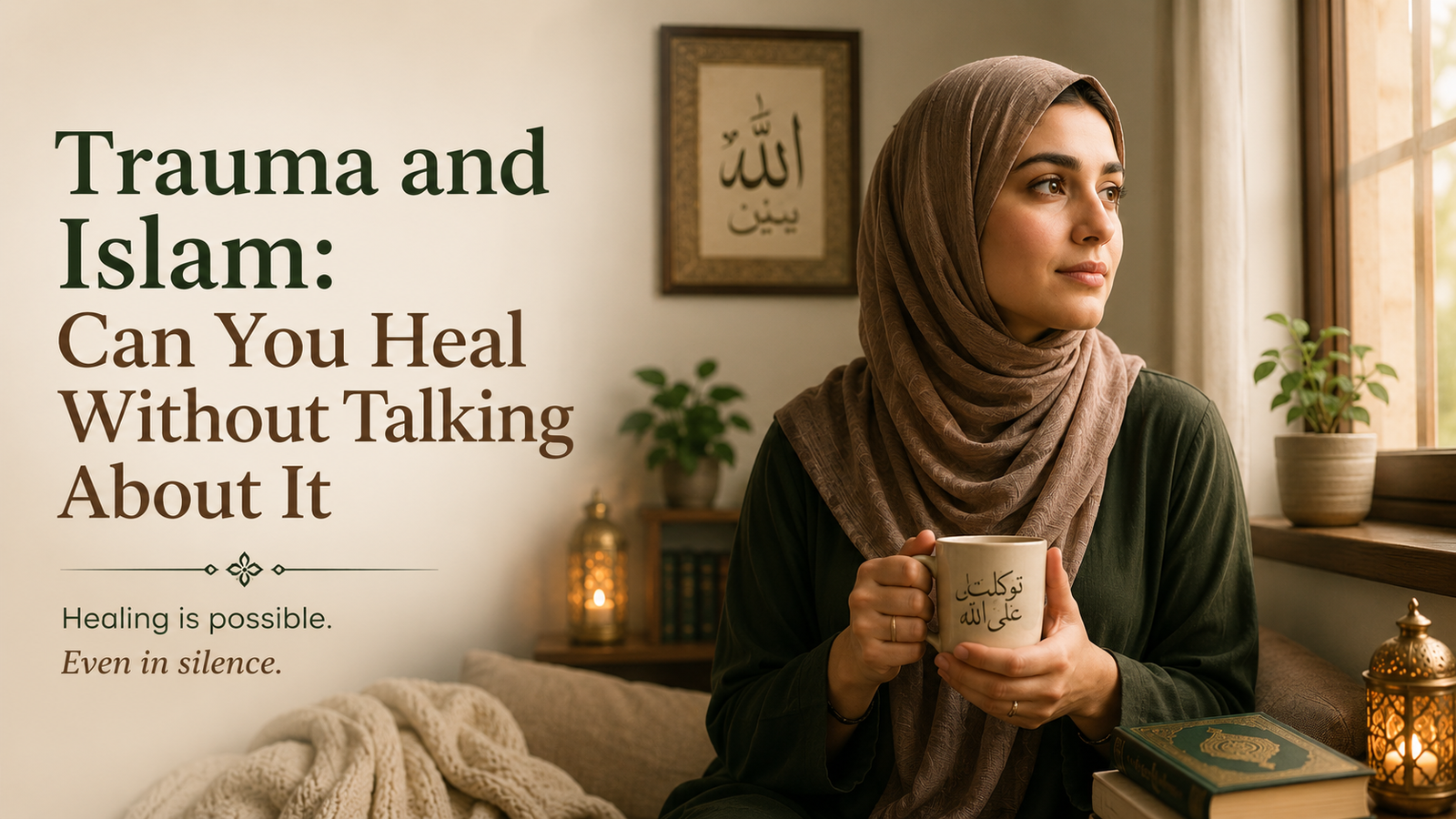
You went through something terrible. You survived it, which took everything you had. You made du’a. You read Quran. You told yourself that Allah does not burden a soul beyond what it can bear. You pushed it down, locked it away, moved on. And then, years later, something small, a smell, a tone of voice, a particular quality of light, brings it back as if it happened yesterday. Why will it not stay gone?
Why trauma does not obey willpower
Trauma is not stored in the mind the way ordinary memories are. This is the key thing that most people do not understand, and it explains why trying to think your way out of trauma, to intellectualise it, to pray it away through willpower alone, so often fails.
When a person experiences an overwhelming event, the brain’s normal memory consolidation process is disrupted. Instead of being processed, filed, and integrated into the broader narrative of your life, the traumatic experience gets stored as raw sensory fragments: the smell, the image, the physical sensation, the emotional intensity. These fragments do not have a timestamp. They do not feel like the past. When they are triggered, they feel like the present. This is why trauma survivors often describe being “taken back” to the event. They are not being dramatic. They are describing a neurological reality.
The body holds trauma in its tissues. Muscle tension, chronic pain, digestive disorders, autoimmune conditions, these are all associated with unprocessed trauma. The body keeps score, as one of the most important books in the field puts it. You cannot think or pray your way out of what is stored in the body without also addressing the body.
What Islam says about the weight of suffering
The Quran does not ask us to pretend that devastating things are not devastating. It does not instruct us to suppress the emotional reality of what we have experienced. The prophetic tradition is full of witnesses to deep human suffering that is acknowledged, honoured, and sat with before it is transcended.
The Prophet Ayyub (AS) cried out to Allah in the midst of prolonged suffering: “Harm has touched me, and You are the Most Merciful of the merciful.” He did not present himself as fine. He named his suffering directly to Allah. And Allah responded. The naming came first.
The Prophet Yaqub (AS) wept for decades over the loss of his son. He did not put it down. He did not move on after an acceptable mourning period. He cried until he lost his sight. He is not presented in the Quran as failing his test. He is presented as a prophet, human in his grief, sustained by his faith.
Islam does not ask for the suppression of suffering. It asks for orientation, for facing it toward Allah rather than away from reality. That is a fundamentally different instruction from “do not feel it” or “do not talk about it.”
Types of trauma that commonly go unnamed in Muslim communities
Part of why trauma goes unprocessed in Muslim communities is that certain experiences are not named as trauma at all. They are normalised, minimised, or treated as things that should simply be forgiven and forgotten.
Childhood physical punishment. In communities where physical discipline is culturally accepted and sometimes religiously framed, the psychological impact of harsh childhood punishment is rarely acknowledged. Adults who were beaten as children often carry complex trauma responses, including difficulty with authority, hypervigilance, and shame, that they have never connected to their childhood experiences.
Domestic violence within marriage. The combination of cultural pressure to preserve the marriage, religious guilt about divorce, and community shame about family problems means that many Muslim women, and some men, carry unprocessed trauma from abusive relationships that they have never been able to name or discuss.
Migration and displacement. Leaving one’s country, whether by choice or by necessity, involves real losses that are often not acknowledged as traumatic. Refugees and asylum seekers carry traumatic experiences from their countries of origin as well as the trauma of the displacement itself. Even voluntary migrants carry complex grief that rarely receives adequate space.
Racism and discrimination. Being on the receiving end of racism, Islamophobia, or sustained discrimination is a form of trauma. Accumulative racial trauma is a recognised clinical phenomenon. It is consistently underdiagnosed in Muslim communities, where there is often social pressure not to complain or to frame discrimination as a test from Allah to be endured quietly.
Sexual abuse. The shame and silence around sexual abuse in Muslim communities is profound. Victims often carry their trauma entirely alone, unable to name it, access support, or receive acknowledgement, because the social cost of disclosure feels too high. This silence causes enormous individual suffering and enables ongoing harm.
Can faith heal trauma?
Faith can be profoundly healing. The research on religion and trauma recovery is genuinely positive. Religious belief provides meaning, community, ritual, and a framework for making sense of suffering that secular frameworks often cannot provide. Many trauma survivors describe their faith as the thing that kept them alive.
But faith alone is not always sufficient. Here is a useful distinction: faith can provide the container for healing, the stability, the meaning, the community, the sense that you are held. But the actual processing of the traumatic material, the integration of fragmented memory, the release of what is stored in the body, often requires specific therapeutic intervention.
It is not either faith or therapy. For most people who have experienced significant trauma, it is faith and therapy together that produces the deepest healing.
What trauma therapy actually involves
Trauma-informed therapy does not require you to relive everything in detail. This is one of the most common fears that prevents people from seeking help, and it is based on a misunderstanding of how modern trauma treatment works.
Approaches like EMDR (Eye Movement Desensitisation and Reprocessing), somatic therapy, and trauma-focused CBT do not ask you to narrate the worst moments of your life repeatedly. They work with the nervous system, with the body’s stored responses, in ways that allow the traumatic material to be processed and integrated without retraumatisation.
A good trauma therapist will never push you beyond your window of tolerance. They will work at your pace. They will help you build safety and stability before approaching the traumatic material directly. They will support you in accessing your own resources, including your faith, as part of the healing process.
Signs that unprocessed trauma may be affecting your life now
Trauma does not announce itself with a label. It shows up in patterns that can seem unrelated to the original experience: difficulty trusting people, relationships that follow the same painful patterns, emotional reactions that feel disproportionate to the trigger, a persistent sense of being unsafe even in objectively safe situations, numbness or disconnection from your own experience, chronic physical symptoms with no clear medical cause.
If you recognise these patterns, consider that there may be something in your history that deserves professional attention. Not because you are broken, but because you deserve to live without carrying it alone.
Healing is possible. You do not have to do it alone.
Our trauma-informed specialists work with the full complexity of your experience, including the spiritual dimension, in a space that is safe, confidential, and grounded in Islamic values. Matched within 48 hours.

