Sleep, the Quran, and Mental Health: What Islam Knew Before Science
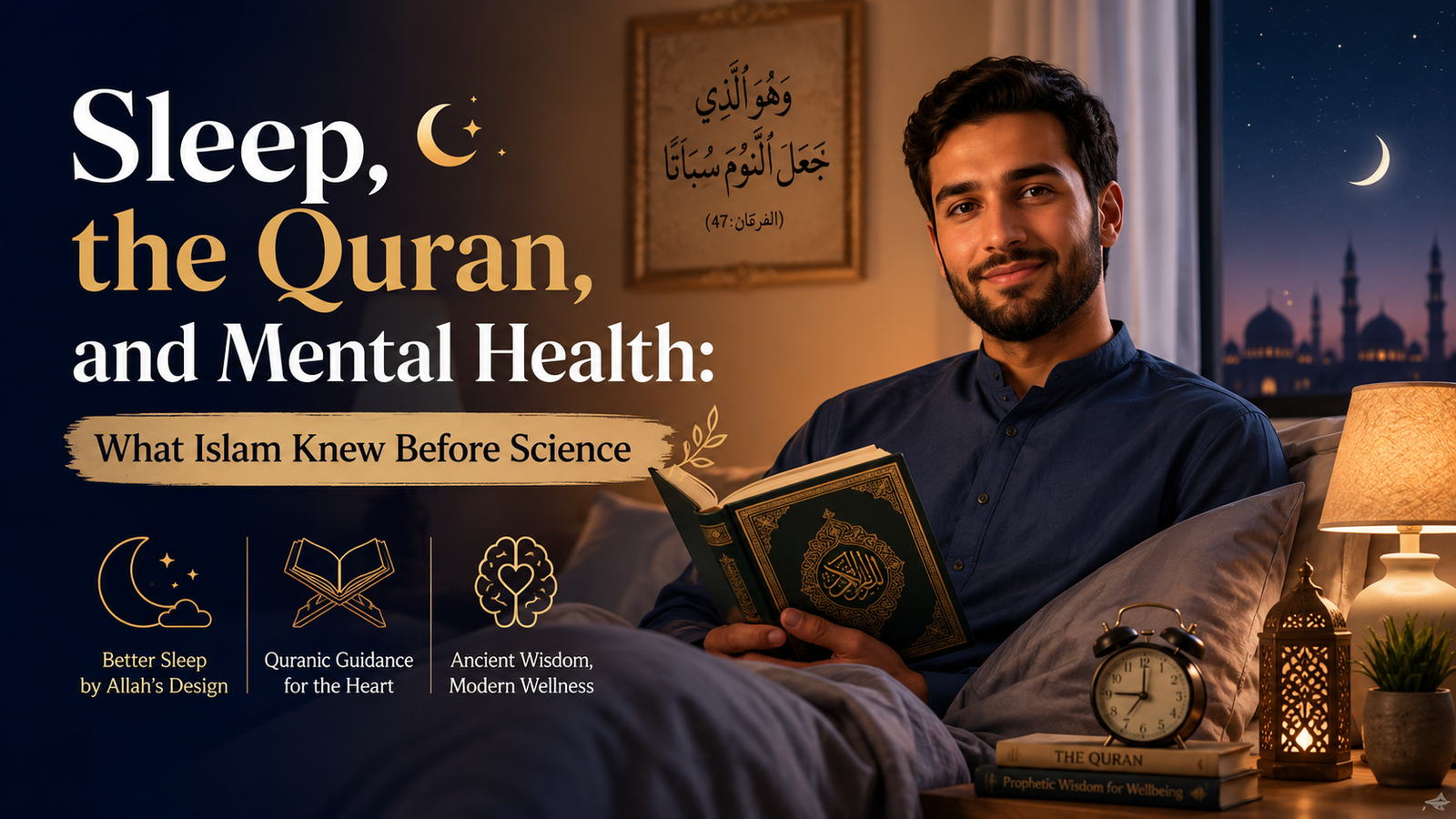
If you told a sleep researcher that fourteen centuries ago, a religious tradition prescribed sleeping early, waking before dawn, taking a midday rest, and avoiding heavy eating before sleep, they would tell you that tradition had, somehow, perfectly aligned with what we now understand about optimal sleep architecture. That tradition is Islam. And most Muslims are not following it.
What the Quran says about sleep
Sleep is mentioned in the Quran as one of Allah’s signs and one of His mercies. “And of His signs is your sleep by night and by day and your seeking of His bounty.” (Surah Al-Rum, 30:23). In Surah Al-Naba, sleep is described as a “rest” or “covering,” using the Arabic “subat,” which carries the meaning of a restorative pause, a cessation that renews.
The Quran also famously describes the taking of souls during sleep: “Allah takes the souls at the time of their death, and those that do not die He takes during their sleep. Then He keeps those for which He has decreed death and releases the others for a specified term.” (Surah Al-Zumar, 39:42). Sleep in this framing is a nightly experience of return to Allah, a small death and revival that mirrors the greater one.
This is not merely poetic. It frames sleep as sacred. As something that happens to us, not something we endure. As a gift that connects us to the divine rhythm of existence.
The Prophetic sleep model
The Prophet Muhammad (peace be upon him) had a sleep practice that, described in secular terms, is remarkably sophisticated.
He slept early after Isha prayer. He disliked staying awake long after Isha without need. He rose for Tahajjud in the final third of the night, a period now known to be associated with the deepest and most restorative stages of sleep architecture. He took a midday rest, the Qailulah, which research has repeatedly confirmed improves afternoon alertness, memory consolidation, and cardiovascular health. He slept on his right side. He made dhikr before sleeping, including reciting the last two verses of Surah Al-Baqarah and blowing on his hands before passing them over his body.
The last practice is interesting not only spiritually but psychologically. The act of creating a consistent, calming pre-sleep ritual is one of the primary recommendations of sleep medicine. It signals to the nervous system that safety is present and that sleep is approaching. The Prophet’s bedtime dhikr functioned, among its spiritual purposes, as exactly this kind of signal.
What sleep actually does for the brain and mental health
The relationship between sleep and mental health is bidirectional and profound. Poor sleep causes mental health problems. Mental health problems cause poor sleep. Breaking this cycle is one of the most important and most overlooked aspects of psychological treatment.
Emotional regulation. The prefrontal cortex, responsible for impulse control, rational thinking, and emotional regulation, is significantly impaired by sleep deprivation. Even one night of poor sleep measurably increases emotional reactivity, specifically increasing the amygdala’s response to negative stimuli by up to 60%. After a poor night, you are biologically less equipped to handle frustration, disappointment, and conflict. This is not a moral failing. It is physiology.
Memory and trauma processing. During REM sleep, the brain processes emotional memories and integrates them into the broader narrative of your life. This is one of the ways that normal stress gets processed and cleared. When sleep is consistently disrupted, this processing does not happen, and emotional material accumulates rather than resolving. People with PTSD have disrupted REM sleep, which partly explains why trauma memories do not integrate the way ordinary memories do.
Anxiety. Sleep deprivation significantly increases anxiety. The anticipatory circuits in the brain become overactive with insufficient sleep, meaning the brain spends more time preparing for threats that have not arrived. Chronic anxiety and chronic sleep deprivation form a vicious cycle that many people live in without recognising it as a cycle.
Depression. The relationship between sleep and depression is so close that disrupted sleep is both a symptom and a cause of depression. Treating insomnia in depressed patients has been shown to significantly improve depression outcomes, sometimes as effectively as antidepressant medication alone.

Why Muslim sleep is often compromised
For all the wisdom embedded in Islamic sleep practice, many Muslims sleep badly. Several factors specific to Muslim life contribute to this.
Fajr disruption without recovery. Waking for Fajr is important and valuable. But waking at 4am or 5am and then staying awake for the day on five or six hours of sleep, without the Qailulah that the Sunnah also recommends, results in chronic sleep insufficiency. The Prophetic model was a complete system. Taking one part of it (the early waking) without another part (the afternoon rest) creates an imbalance.
Late-night religious and social culture. Many Muslim communities, particularly in summer when Isha is late, have a culture of staying up well past midnight for social or religious reasons. Late-night Tarawih, late-night gatherings, late-night family visits. These are not wrong in themselves, but they push sleep later without pushing wake time later, compressing the sleep window significantly.
Ramadan sleep disruption. The month of Ramadan, for all its spiritual beauty, involves significant sleep disruption for many Muslims. Staying up for Suhoor, sleeping after Fajr, attempting to maintain normal work hours. The resulting sleep fragmentation and deprivation has measurable effects on mood, cognition, and physical health during the month.
Anxiety about sleep itself. Many Muslims with insomnia develop a specific anxiety about not sleeping, which makes sleep more difficult. They lie awake worrying about whether they will sleep, which activates the very arousal that prevents sleep. This is a recognised clinical pattern called sleep-onset insomnia, and it responds very well to specific treatment.
Practical steps to improve sleep from both Islamic and clinical perspectives
Revive the Qailulah. A 20-minute rest after Dhuhr is not laziness. It is Sunnah and it is evidence-based. Research on napping consistently shows that brief naps improve afternoon performance, mood, and alertness. If you cannot sleep, simply resting with your eyes closed in a quiet space provides partial benefit.
Establish a consistent sleep and wake time. The single most evidence-based intervention for poor sleep is consistency. Going to bed and waking at the same time every day, including weekends, anchors the circadian rhythm. The Fajr wake time provides a natural anchor if you use it consistently.
Make your pre-sleep routine a form of worship. Combine the Prophetic adhkar before sleep with a deliberate wind-down. Dim the lights an hour before bed. Put the phone away. The blue light from screens suppresses melatonin. This is not just a secular recommendation. Creating a sacred transition into sleep is precisely what the Prophetic sleep routine does.
If sleep problems are persistent and significantly affecting your wellbeing, seek professional support. Cognitive Behavioural Therapy for Insomnia (CBT-I) is the most effective treatment for chronic insomnia and is recommended as the first-line treatment ahead of sleep medication. It works by changing the thoughts and behaviours that maintain insomnia rather than just suppressing symptoms. It can be done online.
If poor sleep is affecting your mental health, we can help
Our psychologists and counsellors address sleep as part of a whole-person approach to mental wellbeing, integrating Islamic practice with evidence-based clinical support. Matched within 48 hours.

