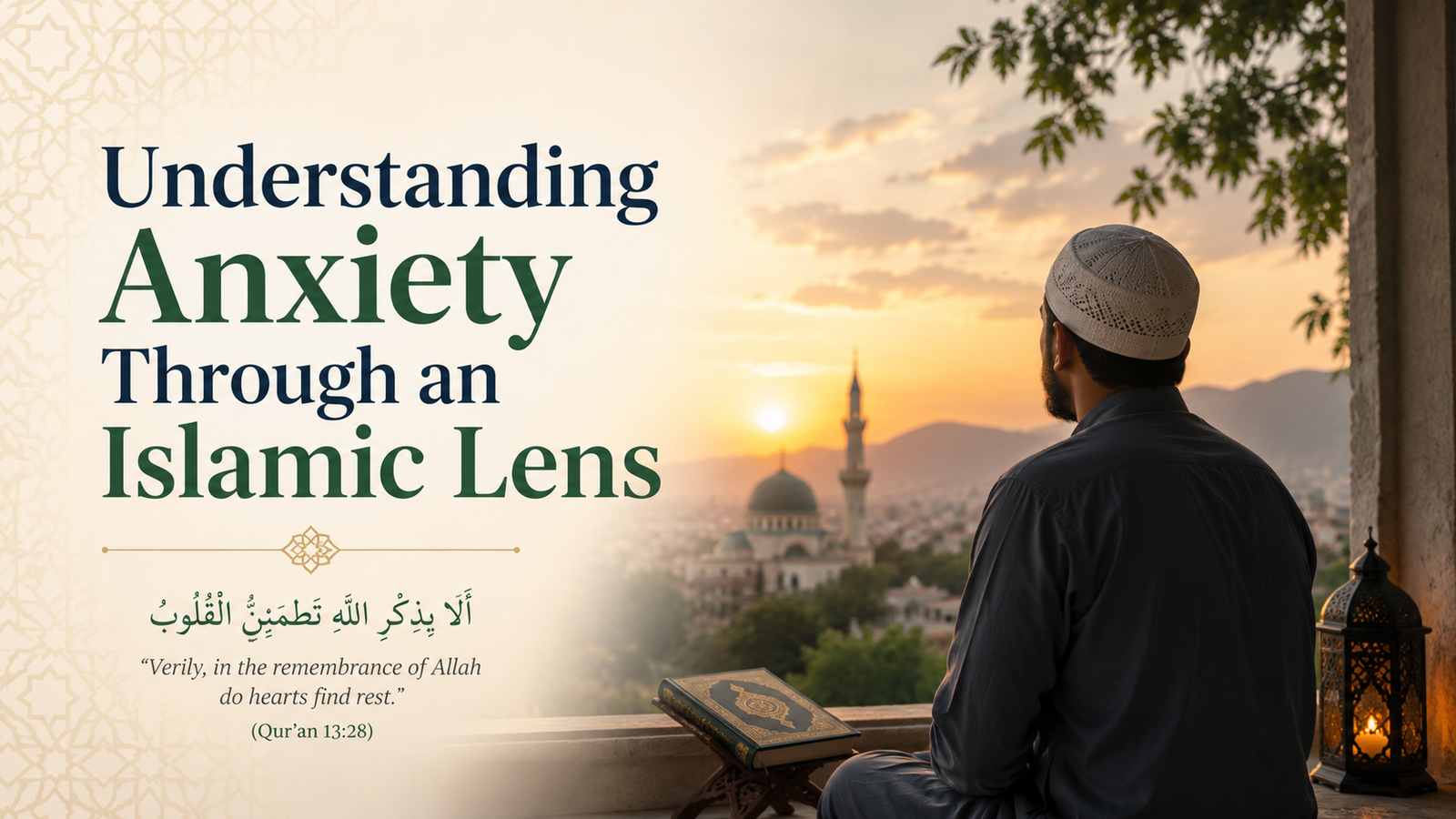
Understanding Anxiety Through an Islamic Lens
Anxiety is among the most common experiences of our time – yet it is not new. The Quran, the Sunnah,
and centuries of Islamic scholarship speak to the restless heart with remarkable depth and compassion.
For Muslims navigating anxiety, there is often an added layer of complexity: the mistaken belief
that feeling anxious is somehow a failure of faith. “If my iman were strong enough, I wouldn’t feel this way.”
This is a painful misconception – and one that Islamic psychology helps us gently untangle.
What does Islam say about anxiety?
The Quran acknowledges the experience of fear and worry as part of the human condition. Allah says:
“We will certainly test you with a touch of fear and famine and loss of property, life, and crops.
Give good news to those who patiently endure.” (Quran 2:155)
This verse does not tell us anxiety will never visit us – it tells us that it will, and that
there is honour in how we carry it. The Prophet Muhammad ﷺ himself made du’a for protection
from anxiety and sadness: “Allahumma inni a’udhu bika minal-hammi wal-hazan” – acknowledging
these as real experiences that require refuge in Allah.
Tawakkul is not passivity
One of the most frequently misunderstood concepts when it comes to anxiety is tawakkul –
reliance on Allah. Many assume this means doing nothing, simply trusting and waiting.
But the Prophet ﷺ corrected this directly: when asked whether to tie his camel or leave it
to Allah, he replied: “Tie it, then put your trust in Allah.”
Tawakkul is the peace we cultivate after we have done what is in our hands. It is not a
substitute for action – including seeking professional help. Seeing a therapist, attending counselling,
and working on our mental health are all acts consistent with Islamic teaching.
The nafs and the nervous system
Islamic psychology understands the human being as layered. The nafs (self or soul) moves
between states – the nafs ammara bis-su that pulls us toward harm, the nafs lawwama
that reflects and regrets, and the nafs mutma’inna – the soul at peace.
Modern psychology describes similar dynamics through the nervous system – the fight-flight-freeze
response of our threat system, and the capacity of the prefrontal cortex to regulate it. These
frameworks complement rather than contradict one another. The goal, in both traditions, is the
same: a settled, regulated self – the mutma’inna – capable of presence, compassion, and clarity.
Practical steps: where Islamic practice and psychology meet
- Dhikr as regulation: Repetitive remembrance of Allah – such as subhanAllah, alhamdulillah, and la ilaha illa Allah – has a documented calming effect on the nervous system. Slow, rhythmic recitation activates the parasympathetic nervous system, lowering cortisol and heart rate.
- Prayer as embodied practice: The five daily prayers impose regular structure – one of the most powerful tools for managing anxiety. They also involve movement, breath, and prostration – all of which have a physiological calming effect.
- Community and accountability: Islam emphasises the ummah. Isolation worsens anxiety. Reconnecting with community – even gently – is both a religious and psychological good.
- Seeking knowledge: Understanding what anxiety is, how it works, and why the brain generates it, reduces the shame and fear of the experience itself. Knowledge is not separate from deen.
- Professional support: When anxiety becomes chronic or disabling, seeking professional help is a form of taking care of the amanah – the trust – of your own wellbeing.
You are not broken
Perhaps the most important thing to hold: anxiety does not mean you have weak faith. The greatest
of people – prophets, scholars, righteous believers – experienced distress, fear, and grief. What
distinguished them was not the absence of these experiences but how they met them: with trust, with
community, with remembrance, and with action.
If you are navigating anxiety and would like support from a specialist who understands both your
deen and your mental health, book a session with Lumosouls. You
don’t have to carry this alone.
“Verily, in the remembrance of Allah do hearts find rest.” – Quran 13:28
This article is for general informational purposes. If you are experiencing a mental health crisis,
please contact a local emergency service or crisis line in your country.

