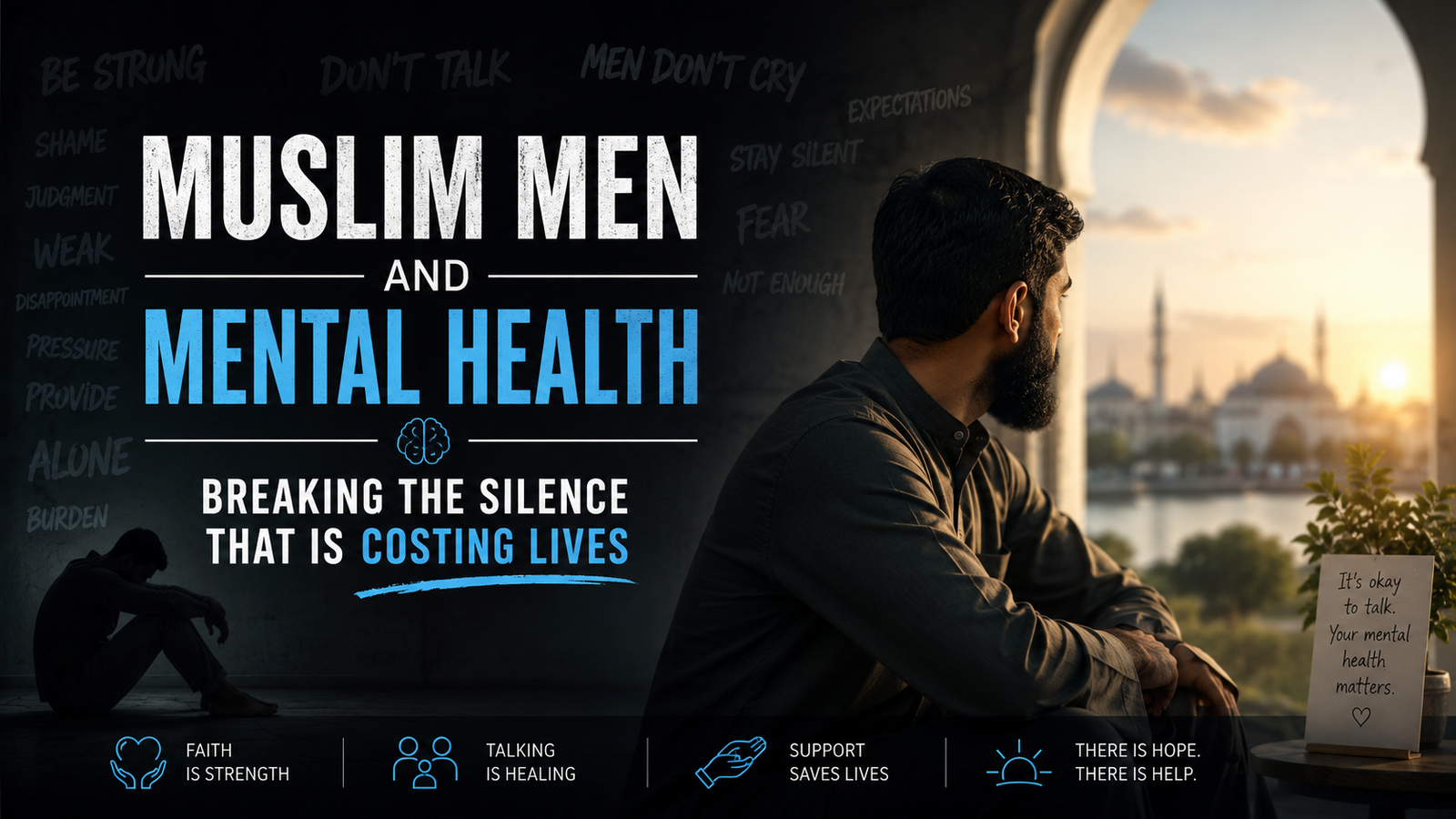
Muslim Men and Mental Health: Breaking the Silence That Is Costing Lives
“I have been the imam of this masjid for twelve years. I counsel brothers every week. Nobody knows I have not slept properly in four months. That I cry in my car before Fajr. That I have thought about not being here. I cannot tell anyone. I am supposed to be the strong one.”
This account, shared by an imam who eventually sought help anonymously, is not exceptional. Across Muslim communities – from London to Lahore, from Toronto to Kuala Lumpur – Muslim men are experiencing mental health crises in silence. Depression, anxiety, suicidal ideation, grief, trauma – all carried alone, often for years, often until crisis point.
The reasons are layered and specific to Muslim cultural contexts. This article addresses them directly, with honesty and without judgment.
The silence is not new – but it is getting more dangerous
Muslim men in many communities have been socialised with a particular understanding of masculinity: the man provides, protects, and perseveres. Emotional vulnerability is seen as weakness. Seeking help is seen as failure. And within religious frameworks, suffering is often framed exclusively as a test from Allah – implying that struggling is shameful and pushing through is piety.
This is not what Islam teaches. But it is what many Muslim men have absorbed.
The consequences are measurable. Studies consistently find that Muslim men are among the least likely demographic groups to seek professional mental health support, despite reporting comparable rates of depression and anxiety to other groups. In the UK, men from South Asian Muslim backgrounds show particularly low rates of mental health service engagement. In the US, Muslim communities overall remain significantly underserved, with men even less represented than women in accessing care.
The data we cannot ignore
The five specific barriers Muslim men face
1. “A real man handles his own problems”
The cultural script is remarkably consistent across South Asian, Arab, African, and Western Muslim communities: emotional struggle is private, strength is silence, and help-seeking is emasculating. Boys absorb this before they are old enough to question it. By the time they are adults, the shame of vulnerability is deep and automatic.
This script is not Islamic in origin. The Prophet Muhammad (peace be upon him) wept at the death of his son Ibrahim. He wept at the grave of his mother. He comforted the Companions in their grief. He described the mu’min as someone whose heart is tender. Tenderness is not weakness in Islamic tradition. It is a mark of depth.
2. “Seeking help means weak iman”
Perhaps the most damaging religious misunderstanding: the belief that struggling emotionally indicates insufficient faith. That if you had enough tawakkul, you would not feel this way. That a truly strong Muslim simply submits and moves on.
This is a distortion. The Prophets – those with the highest iman of any human beings – experienced profound emotional suffering. Ibrahim (AS) was thrown into fire. Yusuf (AS) was betrayed by his brothers and imprisoned for years. Musa (AS) fled in fear. Ayyub (AS) cried out to Allah from his suffering. None of them were shamed for this. Their struggles are preserved in the Quran as examples – not of weakness, but of humanity met with trust in Allah.
3. “Therapy is for non-Muslims”
A significant number of Muslim men believe therapy is a Western, secular concept that conflicts with Islamic values – or that is irrelevant to their situation because their problems are spiritual. This keeps them away from professional support and pushes them toward either isolation or religious-only solutions that may not address the full picture.
Modern psychology emerged from a tradition of understanding the human mind – something Islamic scholars have engaged with for over a thousand years. Al-Razi, Ibn Sina, Al-Ghazali – these were physicians of the body and soul simultaneously. Seeking psychological help is not unIslamic. It is in the tradition of taking the means (asbab) while trusting in Allah for the outcome.
4. “I cannot talk to a therapist who does not understand us”
This barrier is legitimate. Many Muslim men who have attempted mainstream therapy report feeling misunderstood, having their faith pathologised, or receiving advice that conflicts with their values. A therapist who does not understand the role of salah, fasting, gender dynamics in Muslim families, or the weight of community expectations cannot provide fully effective support.
This is not an argument against therapy. It is an argument for finding a therapist who genuinely understands your context – which is exactly what a faith-centered platform makes possible.
5. “What will the community say?”
Muslim communities are tight-knit. This is one of their greatest strengths and one of the most significant barriers to mental health support. The fear of being seen entering a therapist’s office, of a family member finding out, of gossip spreading through the masjid, prevents many Muslim men from seeking help even when they desperately want it.
Online therapy has changed this fundamentally. Sessions via secure video from your own home remove every visibility barrier. Nobody in your community needs to know. This is one of the reasons digital platforms specifically designed for Muslim clients are so important.
The Prophet on seeking help
“Make use of medical treatment, for Allah has not made a disease without appointing a remedy for it, with the exception of one disease – old age.” (Abu Dawud)
The scholars apply this principle broadly to include mental and emotional conditions, not only physical illness.
What Muslim men actually need to hear
Not another list of reasons why they should seek help. But a direct conversation, from one Muslim to another, about what strength actually looks like.
Strength is not the absence of struggle. Every single Companion of the Prophet went through hardship. Umar ibn al-Khattab wept. Bilal was tortured. Abu Bakr’s heart was so tender he could not lead prayer without crying. These were the best of people. Their struggles did not diminish them. They shaped them.
Silence is not sabr. True patience (sabr) is active. It means enduring with dignity while also taking the means available to you. Suffering alone in silence without seeking the help that Allah has provided is not sabr. It is refusing the rope that has been thrown to you.
Your family needs you present, not just providing. Depression, untreated trauma, and chronic stress make you less available to the people who love you – your wife, your children, your parents. Getting help is not selfish. It is one of the most generous things you can do for them.
This is amanah. Your mental and physical health is an amanah – a trust from Allah. You are accountable for how you care for it. Neglecting your mental health is not humility. It is refusing the responsibility of stewardship.
If you are in crisis right now
If you are experiencing thoughts of ending your life, please contact a crisis line in your country immediately. In the UK: Samaritans 116 123. In the US: 988 Suicide and Crisis Lifeline. In Australia: Lifeline 13 11 14.
If you are struggling but not in immediate crisis, the most important thing you can do is talk to someone who understands – professionally, confidentially, and without judgment. You do not have to explain your religion to them or justify your values. You can simply come as you are.
Seeking help is the strongest thing you can do
Lumosouls connects you with vetted Muslim male therapists and counsellors who understand your world. Sessions are private, secure, and conducted via Zoom from wherever you are.

