Anxiety During Pregnancy: What Muslim Women Are Not Being Told
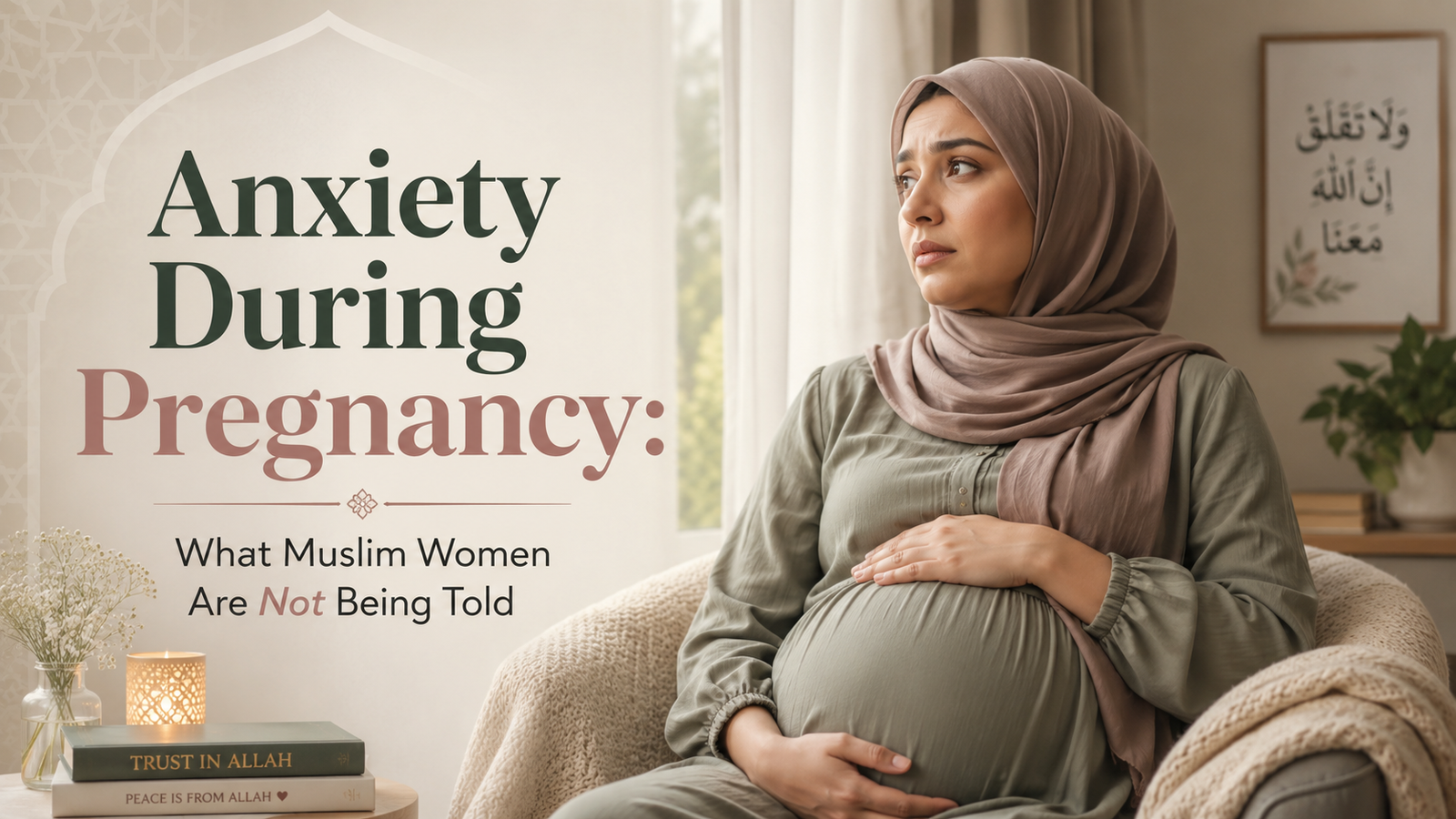
You are carrying a life, and you are grateful. You know you are supposed to be grateful. But underneath the gratitude is something else: a low hum of fear that will not switch off, racing thoughts at 3am, a tightening in your chest when you think about the birth, about the baby’s health, about whether you will be enough. Nobody told you it might feel like this.
The silence around perinatal anxiety
Perinatal anxiety, anxiety that occurs during pregnancy or in the year after birth, affects roughly one in five women. It is more common than postnatal depression, yet it receives a fraction of the attention, the research funding, and the clinical focus.
For Muslim women, the silence runs even deeper. Pregnancy within a Muslim community is often framed almost entirely in terms of joy, gratitude, and spiritual blessing. It is a time when a woman is told she is in an elevated state, that her struggles earn her ajr, that difficulty in childbirth carries its own reward. All of this is true. None of it means anxiety is not real, not significant, and not deserving of proper support.
The result is that many Muslim women white-knuckle through perinatal anxiety, telling themselves they should feel differently, that their anxiety is a sign of weak tawakkul, that they are being ungrateful for a gift that others would sacrifice everything for. This internal narrative does not reduce the anxiety. It adds shame to it.
What perinatal anxiety actually looks like
It does not always look like obvious worry. Many women do not recognise what they are experiencing as anxiety at all. Here is how it commonly presents during pregnancy:
The specific pressures Muslim women face during pregnancy
The performance of gratitude. When a pregnancy is framed primarily as a gift and a blessing, which it is, a woman who is struggling feels she has no right to her struggle. She performs happiness for her family, for her community, for her husband. The gap between the performance and her inner reality is exhausting and isolating.
Extended family expectations. In many Muslim families, pregnancy brings with it a dense web of expectations: about how to eat, how to rest, what to do and not do, who will be present at the birth, what the baby will be named, how the household will be managed afterwards. Navigating all of this while also managing physical symptoms and internal anxiety is a significant cognitive and emotional load.
Previous pregnancy loss. Miscarriage is tragically common. In Muslim communities it is often processed very quietly, sometimes almost privately, with limited acknowledgement of the grief involved. A woman who has experienced pregnancy loss and is now pregnant again frequently carries a particular brand of hypervigilant anxiety that is completely understandable and completely underserved.
Fear about being a good Muslim mother. There is a specific anxiety that many Muslim women carry about whether they will raise their children correctly in the faith, whether they will be able to instil the values they care about, whether they will be enough. This can feel urgent and overwhelming in a way that non-Muslim mental health professionals may not fully understand.
Healthcare settings that do not understand them. Muslim women regularly report feeling unseen in NHS or general healthcare settings during pregnancy. Their modesty concerns, their fasting during Ramadan if pregnancy coincides, their preferences around gender of healthcare providers, their family involvement in decisions, these are routinely either not asked about or handled insensitively. Feeling unseen in a healthcare system adds to the anxiety of using it.
What Islam actually says about struggle during pregnancy
The Quran acknowledges the physical and emotional weight of pregnancy directly: “His mother bore him with hardship and gave birth to him with hardship.” (Surah Al-Ahqaf, 46:15). The word used for hardship, “kurh,” describes something genuinely difficult, distressing, and burdensome. It is not a mild inconvenience. The Quran does not airbrush pregnancy into a purely joyful experience. It witnesses its difficulty.
This matters. You are not failing your deen by finding pregnancy hard. You are not demonstrating weak iman by experiencing anxiety. You are experiencing something the Quran itself describes as genuinely difficult. Seeking support for that difficulty is taking care of a trust that Allah has placed in your body and mind.
Why untreated perinatal anxiety matters beyond you
This is not alarmist. It is important. Research is clear that untreated anxiety during pregnancy has measurable effects on birth outcomes, on the mother’s experience of labour and birth, and on the early mother-child relationship. Anxiety that is not addressed during pregnancy very frequently becomes postnatal anxiety or depression after birth, when you are also dealing with the profound physical and emotional upheaval of new motherhood.
Getting support during pregnancy is not selfish. It is one of the most practical things you can do for your baby and for your family.
What actually helps
Name it to your midwife or GP. Perinatal mental health is now a mandatory part of antenatal care in the UK. You will be asked screening questions. Answer them honestly. The Edinburgh Postnatal Depression Scale is used during pregnancy too, not just after birth. If you feel your concerns are not being taken seriously, ask for a referral to your perinatal mental health team.
Cognitive behavioural therapy (CBT) is highly effective for perinatal anxiety. It is safe during pregnancy, it has a strong evidence base, and it does not require medication. Many NHS trusts have specialist perinatal mental health services that offer CBT specifically adapted for pregnancy and the postnatal period.
Talk to someone who understands your cultural context. This is where the gap in mainstream services is most significant. A Muslim counsellor or psychologist who understands the specific pressures you are carrying, the gratitude guilt, the family dynamics, the faith dimension, can work with you in a way that general services often cannot.
Give yourself permission to need support. This is the hardest one. The internal narrative that you should be fine, that others have it harder, that you should count your blessings, is a barrier to seeking help that you will have to actively push against. It is worth pushing against. You deserve support during one of the most demanding experiences a human being can go through.
Support that understands what you are carrying
Our female Muslim counsellors and psychologists specialise in perinatal mental health and understand the cultural, spiritual, and emotional landscape of pregnancy. Matched to you within 48 hours, online.

