When Sadness Becomes Depression: How to Tell the Difference as a Muslim
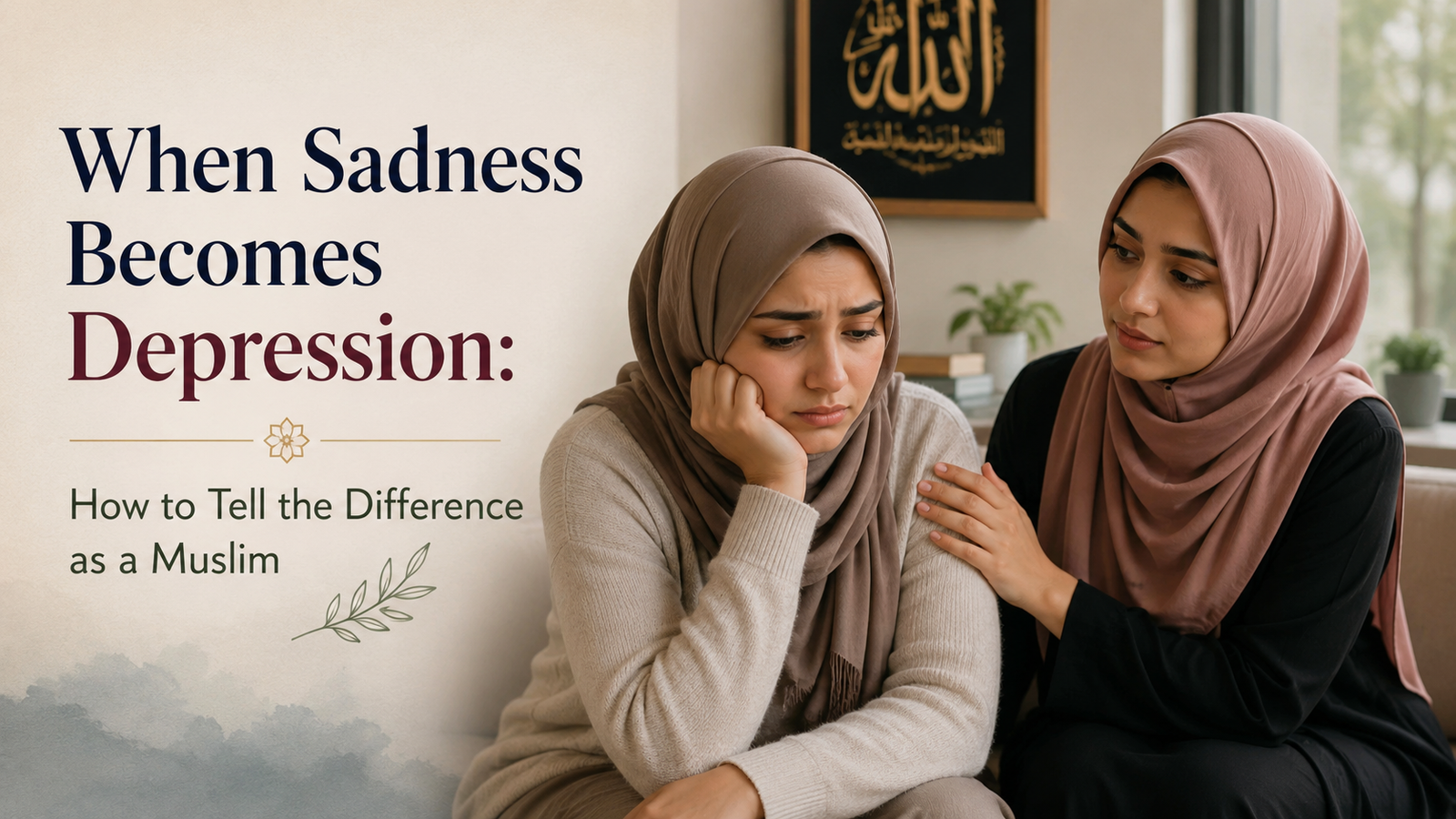
You have been feeling low for weeks. You are going through the motions. The things that once brought you joy feel distant. You pray, but the khushoo is gone. You fast, but you feel empty. Is this just sadness? Is this a test from Allah? Or is something else going on?
This question matters more than most Muslims realise. Mistaking depression for ordinary sadness leads people to wait it out, to pray harder, to push through, when what they actually need is clinical support. And mistaking ordinary sadness for depression leads to unnecessary alarm and, sometimes, unnecessary medication.
This article will give you a clear framework for understanding the difference, rooted in both Islamic understanding and clinical psychology.
What Islam says about sadness
The Quran does not treat sadness as a spiritual failing. It is mentioned repeatedly as a natural human experience. The Prophet Yaqub (AS) wept so deeply for his son Yusuf that he lost his sight. The Prophet Muhammad (peace be upon him) experienced what scholars describe as the “Year of Sorrow” after the deaths of Khadijah and Abu Talib. He was not reproached for his grief. He was comforted by revelation.
Sadness in Islam is not something to be ashamed of or suppressed. It is a signal that you love, that you care, that you are human. The Quran says: “Verily, with hardship comes ease.” It does not say hardship is not real. It acknowledges the hardship first.
What Islam does discourage is allowing sadness to calcify into hopelessness, into the belief that Allah’s mercy cannot reach you. That distinction matters clinically as well as spiritually.
What sadness actually is
Sadness is an emotional response to a specific cause. You lost someone. A relationship ended. You failed at something that mattered to you. You received bad news. The sadness is proportionate to what happened, and it moves. Given time, support, and the natural grieving process, it lifts.
Sadness allows you to function. You still get out of bed, even if it is hard. You still feel moments of relief or lightness. You can still connect with people, even if you pull back a little. Your sense of self remains intact. You know this will not last forever.
What depression actually is
Depression is not sadness that has gone on too long. It is a distinct clinical condition that changes the way the brain functions. It alters neurochemistry, disrupts sleep and appetite, distorts thinking, and strips the capacity for pleasure from experiences that would normally bring it.
The clinical definition of a major depressive episode requires five or more of the following symptoms, present for at least two weeks, causing significant impairment:
Notice that sadness is only one item on that list. Depression is far broader. Many people with depression do not feel particularly sad. They feel numb, empty, disconnected. They describe it as living behind glass, watching their own life from a distance.
The signs that distinguish depression from sadness
Duration without cause. Sadness has a reason and it shifts over time. Depression persists even when circumstances improve. If you have been consistently low for more than two weeks with no clear relief, that is significant.
Anhedonia. This is the loss of pleasure in things you used to enjoy. It is one of the most reliable markers of depression. If you cannot feel enjoyment from anything, if your favourite food tastes like nothing, if spending time with people you love feels pointless, if even your connection to your deen feels switched off rather than simply strained, that warrants attention.
Physical symptoms. Depression lives in the body. Persistent fatigue that sleep does not fix. Unexplained aches and heaviness. Changes in appetite with no obvious cause. Many Muslims see their GP for physical symptoms for years before anyone considers that depression might be the underlying driver.
Cognitive distortion. Depression changes how you think, not just how you feel. It creates a specific pattern: pervasive hopelessness about the future, harsh self-criticism, and the sense that your situation is permanent and entirely your fault. These thoughts feel completely true from inside the depression. They are not.
Functional impairment. Sadness is hard. Depression makes ordinary functioning genuinely difficult. When getting out of bed, maintaining basic hygiene, or doing your job becomes a monumental effort day after day, that is beyond what sadness does.
How depression can look different in Muslim communities
Research consistently shows that depression presents differently across cultures. In many Muslim communities, the emotional symptoms are minimised or not recognised as depression, while the physical symptoms take centre stage. People talk about their chest being tight, their body being heavy, their head aching constantly. They seek medical tests that come back clear, and they are sent home without a psychological assessment.
There is also a specific pattern around religious engagement. For a practising Muslim, one of the early signs of depression is often a change in their relationship with salah and Quran. Not abandoning them necessarily, but losing the connection. Praying mechanically. Finding the words of the Quran fail to move them the way they used to. This is often experienced as a spiritual crisis, as evidence that Allah is displeased with them, when it is in fact a symptom of a clinical condition affecting the brain’s capacity for emotional response.
This matters enormously. Interpreting a depression symptom as a spiritual failing causes the person to redouble their religious efforts in ways that, without clinical treatment alongside them, will not be enough to lift the depression and will ultimately reinforce the shame spiral.
What to do if you think you might be depressed
The first step is to name it without shame. Depression is an illness, not a character flaw, not a sign of weak iman, not Allah’s punishment. The Prophet (peace be upon him) said: “There is no disease that Allah has created, except that He also has created its treatment.” That includes depression.
Speak to your GP. A clinical assessment matters. Depression exists on a spectrum and the appropriate response varies accordingly. Some people benefit from therapy alone. Some benefit from medication. Many benefit from both, especially alongside spiritual support.
Do not wait until you are at rock bottom. Early intervention consistently produces better outcomes than waiting until the depression is severe and entrenched.
Tell someone you trust. Isolation worsens depression. The instinct to withdraw and manage it privately, common in Muslim communities where mental health stigma remains significant, works against recovery. Human connection is not a luxury during depression. It is part of the treatment.
A note on suicidal thoughts
If you are experiencing thoughts of ending your life or harming yourself, please reach out for help today. This is a medical emergency in the same way that chest pain is a medical emergency. It does not mean you are sinful. It means you are very unwell and you need immediate support.
Contact your GP, go to your nearest A&E, or call a crisis line. In the UK, the Samaritans are available 24 hours a day on 116 123. In the US, the 988 Suicide and Crisis Lifeline is available by calling or texting 988.
You do not have to figure this out alone
Our Islamic psychologists and counsellors are trained to support Muslims navigating depression, with full understanding of the spiritual and cultural dimensions. Matched to you personally, within 48 hours.

