Islamic Counselling vs Regular Therapy: What Is the Difference and Which Do You Need?
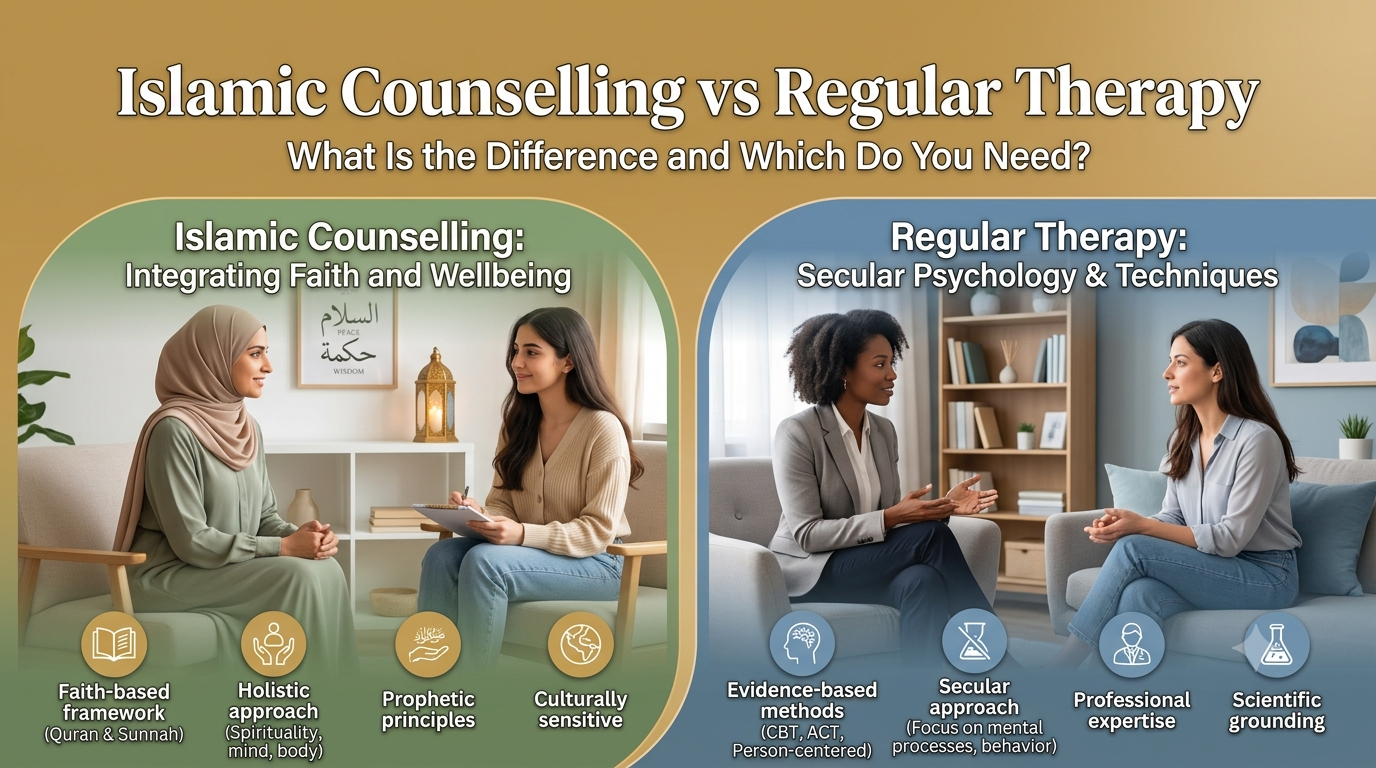
“I tried a regular therapist once. She was kind, but when I tried to explain why divorce was complicated for me religiously, she kept saying ‘but your feelings are valid regardless of what your religion says.’ She did not understand that my religion IS part of how I understand my feelings. I left after four sessions.”
This experience is common. The Muslim client arrives at a mainstream therapist’s office carrying not just their presenting problem but an entire worldview – one in which Allah is real, in which community accountability matters, in which gender and family obligations have specific meaning, in which the afterlife shapes how present suffering is understood. When the therapist cannot hold that worldview, something crucial is lost.
At the same time, not every Muslim needs specifically Islamic counselling. And not everyone who calls themselves an Islamic counsellor is qualified to address serious mental health conditions. Understanding the landscape is essential before you make a choice.
First: what do we mean by “regular therapy”?
Mainstream therapy encompasses dozens of different modalities, each with its own theory of mind, its own techniques, and its own evidence base. The most common include:
Focuses on the relationship between thoughts, feelings, and behaviours. Evidence-based for anxiety, depression, OCD, PTSD. Very structured and skills-based.
Explores unconscious patterns, early relationships, and how past experiences shape present behaviour. Longer term, more exploratory.
Specifically designed for trauma. Helps the brain process and integrate traumatic memories. Highly effective for PTSD.
Emphasises the therapeutic relationship, unconditional positive regard, and the client’s own capacity for growth. Less structured, very relational.
All of these approaches are grounded in secular psychological frameworks – which means they do not inherently incorporate religious belief, spiritual experience, or faith-based meaning-making. A skilled therapist can apply them sensitively regardless of a client’s religion. But the framework itself is neutral at best toward faith, and occasionally in tension with it.
What is Islamic counselling, really?
Islamic counselling is not a single, standardised modality. It is better understood as an approach that integrates psychological principles with Islamic values, beliefs, and practices. A skilled Islamic counsellor does all of the following:
- Uses evidence-based therapeutic techniques (often CBT, person-centred, or integrative approaches)
- Understands the Islamic conceptual framework: nafs, ruh, aql, tawakkul, sabr, tawbah
- Can incorporate Islamic practice (dhikr, du’a, salah, fasting) as therapeutic tools when appropriate
- Is culturally competent across Muslim backgrounds (South Asian, Arab, African, Western convert)
- Can navigate gender, family, and community dynamics within an Islamic framework
- Knows when a concern is a genuine religious question and when it is a psychological pattern using religious content
Critically, Islamic counselling is not simply talking to a Muslim who happens to be kind. A qualified Islamic counsellor has professional psychological training AND deep Islamic knowledge. Without both, there are significant gaps.
What Islamic life coaching is – and how it differs from counselling
Life coaching is not therapy. An Islamic life coach is not equipped to treat mental health conditions such as depression, anxiety disorders, trauma, or psychosis. What a life coach does well is help you identify goals, remove obstacles, build habits, and reconnect with your values and purpose. If your question is “how do I align my life with my deen?” or “how do I move forward after a major change?” – coaching may be exactly what you need. If your question is “why do I feel this way and how do I stop?” – you need a counsellor or psychologist.
A simple rule of thumb
If the problem is about the past – trauma, patterns, conditions – you need a therapist or psychologist. If the problem is about the future – goals, direction, growth – a coach may serve you well. Many people need both at different stages.
The comparison: Islamic counselling vs regular therapy
| Aspect | Regular therapy | Islamic counselling |
|---|---|---|
| Framework | Secular psychological models | Psychological models + Islamic framework |
| Faith integration | Depends entirely on the therapist | Central to the approach |
| Cultural competence | Variable, often limited | Core competency |
| Can treat OCD, PTSD, depression | Yes, if properly qualified | Yes, if clinically trained |
| Understands waswas, halal/haram anxiety | Rarely | Yes, specifically |
| Can use dhikr and prayer as tools | Unlikely | Yes, intentionally |
| Will challenge Islamic beliefs | Risk of this, unintentionally | No – values are respected |
| Availability | Very widely available | Limited – specialist field |
Which do you need? A practical guide
Choose Islamic counselling / a Muslim therapist if:
- Your problem is significantly shaped by Islamic values, obligations, or community
- You have had negative experiences with mainstream therapists misunderstanding your faith
- The concern involves family dynamics specific to Muslim culture (arranged marriage pressure, community shame, etc.)
- You want to use Islamic practice as part of your healing, not around it
- You are dealing with waswas, OCD with religious content, or spiritual crisis
A skilled secular therapist may serve you well if:
- The presenting issue is not significantly shaped by your faith context
- You have found a therapist who is genuinely respectful and curious about your beliefs
- You need a highly specialist modality (e.g. EMDR for trauma) and no Islamic practitioner offers it in your area
You may need both if:
- You have a serious mental health condition that requires specialist clinical input AND want faith-integrated support alongside it
- You want life coaching to move forward AND psychological support to process the past
The most important thing is not which category you choose. It is that you choose something – and that you do not let the perfect become the enemy of the good. An imperfect fit with a willing, respectful therapist is far better than suffering alone while searching for the ideal one.
Let us find the right match for you
Lumosouls matches you with the right specialist for your specific concern – whether that is a psychologist, counsellor, or life coach – always grounded in Islamic values.

